
Feb. 23, 2026
Our past three editions
Feb, 9 2026 Olympics • AI • PepsiCo
Feb. 2, 2026 Doomsday Clock • Minneapolis • Wired headphones
Jan. 26, 2026 ICE • Olympics • TikTok
THE LEAD
‘Quad god’ shares brief glimpse into intense pressure Olympians can feel
Take a look at athlete mental health on the local stage
All eyes were on Ilia Malinin, the self-proclaimed, “Quad God,” during his individual program skate at the Olympics. But his skate did not go as planned. Malinin fell twice during his free skate, taking him off of the podium.
In the wake of this performance, Malinin opened up on social media about the pressure he feels to perform.
“On the world’s biggest stage, those who appear the strongest may still be fighting invisible battles on the inside,” he wrote on Instagram. “Vile online hatred attacks the mind and fear lures it into the darkness, no matter how hard you try to stay sane through the endless insurmountable pressure. It all builds up as these moments flash before your eyes, resulting in an inevitable crash.”
He teased a full video that will be released Feb. 21 (at the time the Scroll is published, it had not yet been released).
Malinin is not the only athlete to open up about the intense pressure that comes with the Olympics — Simone Biles, Michael Phelms and Naomi Osaka have all shared their experiences, ABC News reported.
What you can do —
Though athletes in your community likely don’t feel Olympic-levels of pressure to perform, it is worth talking to star athletes about the effects of pressure, whether self-inflicted or from external sources. It is also a good idea to talk to a sports psychologist or other relevant expert. How can people deal with online pressure? How does external pressure affect athletic performance?
This is also a news hook for a story generally about athlete mental health. There is research into the benefits of physical activity, but also there can be environments where it is harmful. Talk to experts, athletes and coaches about how they navigate mental health.

Noteworthy
Young adults more likely to get news on social media than seeking it out, Pew Research Center finds
Examine news consumption habits, explore new sources during Scholastic Journalism Week
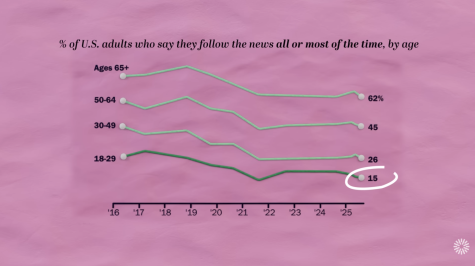
More than 75% of Americans ages 18-29 get their news from social media, a December study by Pew Research Center shows. In many cases, this means younger consumers are more likely to get news without seeking it out. The older people are, the more likely they are to intentionally follow the headlines, according to Pew.
Young Americans are also more likely to trust information from social media, and less likely to trust national and local news organizations. Their definition of what a journalist is is broader than many older Americans — and often includes podcasts hosts, newsletter writers and content creators.
What you can do —
This Scholastic Journalism Week, have a critical conversation about how students on student media — and your wider school community — consume news. Do students read traditional media? Do teachers and staff trust social media information? How has that divide changed?
Another tool that could be helpful in this discussion is the newest edition of Ad Fontes Media’s Media Bias Chart, which features 127 web and print sources. Take a look at the new chart (or their interactive listing) and see what sources you gravitate towards. Encourage your peers to vary their news diet in the coming weeks.
What’s viral
Colbert says CBS scrapped interview with a Democratic Senate candidate
Discuss differences in First Amendment protections between broadcast and print
Last week Stephen Colbert said CBS lawyers stopped him from airing an interview with Democratic Senate primary candidate James Talarico. CBS says Colbert was given “legal guidance” but was not “prohibited” from airing the interview, CNN reported.
This comes after the Federal Communications Commission recently published new guidance concerning the “equal time” rule, an old regulation that applies to local TV and radio stations (but not streaming or cable).
The rule, established almost 100 years ago, requires broadcasters to give equal airtime to all candidates for public office. There are exemptions for news coverage and, for the last two decades, for late night and daytime talk shows, CNN reported. However, Brendan Carr, the FCC chair, is rejecting that thinking.
What you can do —
There have been many headlines about late night shows and the FCC in the last few months. For a journalism class or club, it is an interesting opportunity to discuss the history of limitations on broadcast coverage — and how the landscape is changing. Talk to experts about what changes to the FCC mean for journalism and free speech, and be sure to touch on the business elements complicating these discussions. (CBS has been under elevated pressure because its parent company is trying to acquire Warner Bros. Discovery)

100 years of Quill & Scroll
Gallup calls for more reading, writing in school
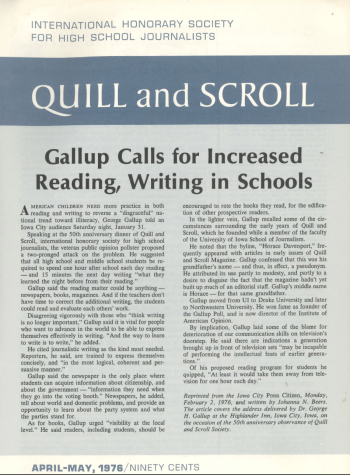
At a celebration of Quill and Scroll’s 50th anniversary in 1976, George H. Gallup suggested that all high school and middle school students spend an hour a day reading, and 15 minutes writing about what they read, according to an Iowa City Press Citizen article published in the Quill and Scroll magazine.
He pointed to television as partly to blame for the deterioration of communication skills in the younger generation and espoused the benefits of scholastic journalism to counteract that.
The media landscape looks remarkably different today than it did in 1976, but Gallup’s point still has some merit. How have evolving media formats changed the curriculum at your school? How have they affected your media habits? Take some time to discuss this during Scholastic Journalism Week.
Share your Quill & Scroll story
In honor of the centennial, Quill and Scroll is collecting testimonials, memories and stories from Quill and Scroll from student members, advisers, former staff and friends.Thank you for taking a few minutes to share your experiences on this form! Your answers may be used in marketing and communications materials.
Please share with others in your network — we want to hear from everyone.
IT’S AN HONOR
It’s always membership season
Don’t forget you can nominate members year round
Now is the best time to order for your induction! Not only will you beat the ordering rush, you could also have Quill and Scroll function as a journalism club or volunteer organization. (And don’t worry, if you’re worried that having chapter activities will just add another to do time to the list, we have several suggested chapter activities in “lesson plan” format so students can lead these!) While you’re ordering, don’t forget to include any cords and other Quill and Scroll materials and memorabilia.
We haven’t changed the ordering process from last year. For those wanting to ditch the paper version, you just need to select the form based on how you would like to pay. We have one version for credit card and another version for check or purchase order. (We’ve added buttons for ease of finding these.) As usual, credit card payments are charged $4.49 per order for processing.
If your initiation is the week of March 16 or before, now is the time to order!
Take advantage of our advisers-only resource area
Quill and Scroll has expanded its advisers-only area, which includes bellringers and lesson plans for advisers who have initiated members within the past school year.
Advisers, if you inducted members in the 2024-25 or the 2025-26 school year, check your email (and your spam!) for a message from [email protected]. That email should contain your login information. Please be sure to accept cookies when you log in! If you have trouble, you can contact us at [email protected]. If you have inducted members this school year, we update access every few weeks, so keep an eye on your email.
Members-only area highlight
This quick copy slideshow highlights five commonly confused issues. Follow it up with the Three Steps to Copy Editing slideshow to smooth out your whole process.
School of the New York Times Summer Academy opportunity
The School of the New York Times Summer Academy is one of the nation’s most competitive journalism programs – and Quill and Scroll members get an exclusive discount. ($500 off and refer/bring a friend incentives).
Summer Academy is open to high school students (grades 10-12 and Graduating Seniors based on the grade the student is entering in the Fall 2026 school year). Students must be 15-years old by the first day of their session. Program graduates have been recruited from some of the top journalism schools in the nation. Please see this link for the course catalogue.
All students applying to Summer Academy for the first time are required to complete an online application. Returning students do not need to reapply. As a member school, Quill and Scroll chapter members receive priority enrollment.
Additionally, the winning entries from our News Writer of the Year (Category 16 in Quill and Scroll’s Writing, Visual, Multimedia Contest) are eligible to compete for a School of the New York Times scholarship to its Summer Academy. This scholarship (valued at $7,500) includes room and board but not transportation to New York City. Student entries will be evaluated by faculty from the New York Times.
The School of the New York Times is hosting a Virtual Open House Feb. 24.
To unlock your member benefits and request your Quill & Scroll discount, please click here.
Opportunity for those interested in climate reporting
Now in its fifth year, Youth Environmental Press Team’s (YEPT) mission is to amplify youth urgency on the climate crisis by supporting young people in producing journalistic content on climate and the environment and sharing it with their peers as well as the general public.
YEPT republishes climate- and environmental-related content produced by high school journalists in their school newspapers on our yept.org website, along with publishing original content. Stories include a wide spectrum of student-selected subject matter related to climate impacts: invasive species, data centers, animal agriculture, renewable energy, global climate politics, and much more. Republication requires permission of writer and faculty advisor/teacher and nets the student $30. We also assign fresh content for our site: $100 or more for a new assignment, depending on complexity.
As of November, 2025, over a dozen high school Directors representing 10 states contribute to YEPT: Colorado, Texas, Nebraska, Missouri, Wisconsin, Illinois, Indiana, Michigan, Kentucky, and Ohio, with other states in the process of joining (pending additional funding). For example, we regularly publish writers from Iowa and California as well as the United Kingdom. Directors help run YEPT, produce stories, and promote YEPT content and the program itself on social media, LinkedIn, and other platforms; each state Director is paid $1,000 per semester for this work.
For more information, contact adult adviser Jim Poyser at [email protected]
Spring convention registration open
Join us in Minneapolis for the JEA/NSPA National High School Journalism Convention. Registration opened Jan. 8 and the hotel link was sent to all registrants Feb. 3.
Attendees can look forward to preconvention workshops, media tours, critique and contest opportunities, a publication exchange and hundreds of informational sessions. Come “Find your North Star” at the JEA/NSPA spring convention April 16-18.
Quill and Scroll also will celebrate its centennial year at the Thursday evening adviser reception.
Opportunity from the Freedom Forum
The Al Neuharth Free Spirit and Journalism Conference June 21-26, 2026, provides 51 students (one high school junior from each state plus the District of Columbia) with an all-expenses-paid program that includes panel conversations with journalists and multimedia storytellers, newsroom visits, networking events, a chance to meet students and industry leaders who share a passion for news, and a unique Washington, D.C., experience.
Participants receive a $1,000 college scholarship and ongoing support from a community of more than 1,700 alumni. Students build their skills, grow their network and get a head start on their future.
The due date is March 15.
Upcoming Weekly Scroll pause dates
We will pause the Weekly Scroll during the weeks of March 9, March 23, April 13 and April 20 since we will be at conventions when we normally would amass the Scroll.
Some advisers and students have found linking to our Weekly Scroll page beneficial.
Thank you for understanding.
Just a thought
Happy Scholastic Journalism Week!
We hope you take time to celebrate the week with your students.
Take time this Scholastic Journalism Week — and specifically Student Press Freedom Day — to discuss the role of the First Amendment in democracy today. If you are looking for activity ideas, here are some Quill and Scroll has complied:
- Student press protections: What is the status of the free press in your school and state? Are you one of the 18 states with laws that protect student journalists? What are the policies and guidelines at your school? What is the role of the student press? This could be a great activity in preparation for or following Student Press Freedom Day.
- Why Journalism Matters: Why does journalism matter? Why is it more important than any time in recent history to make sure we cover our local communities? (Hint: many cuts to local journalism have occurred nationwide.)
- Constitution Day: This beginning-of-the-year activity can help you and your students learn about the First Amendment.
- This Scroll! The second and third stories make great talking points for the week.
The Journalism Education Association has a variety of lesson plans on its website and the Student Press Law Center has a variety of opportunities on its website.
— Lori Keekley